Know what your next Claude Code message costs.
Step away for lunch and Claude Code's cache goes cold. Your next message then pays to rewrite the whole conversation: 25× what re-reading it costs on Opus 5.5. This band shows the countdown and the price, right above the prompt.
$ claude plugin install session-usage-band \
    --marketplace HMarzban/claude-mod
What a lunch break costs.
Claude Code keeps your conversation in a cache. Come back in time and the next message re-reads it for pennies. Come back late and it pays to write the whole thing again.
On with 340k tokens in context, your next message costs:
Where these numbers come from
The context part of the next message, at list prices per million input tokens: Opus 5.5 $4, Sonnet 5.5 $2, Fable 5.1 $10. A warm cache read costs 0.05× of that on Opus 5.5 and Sonnet 5.5 and 0.025× on Fable 5.1, and rewriting the cache 1.25×, as Claude Code's own cost display counts it. Anthropic bills a 1-hour cache write at 2×, and Claude Code uses the 1-hour cache on a subscription, where these tokens come out of your plan's usage limits rather than your card. Prices from Anthropic's pricing page, October 2026.
An hour, in seventeen seconds.
Every band in this film is the mod's own output, with the clock moved forward.
Every number that decides your bill, in one row.
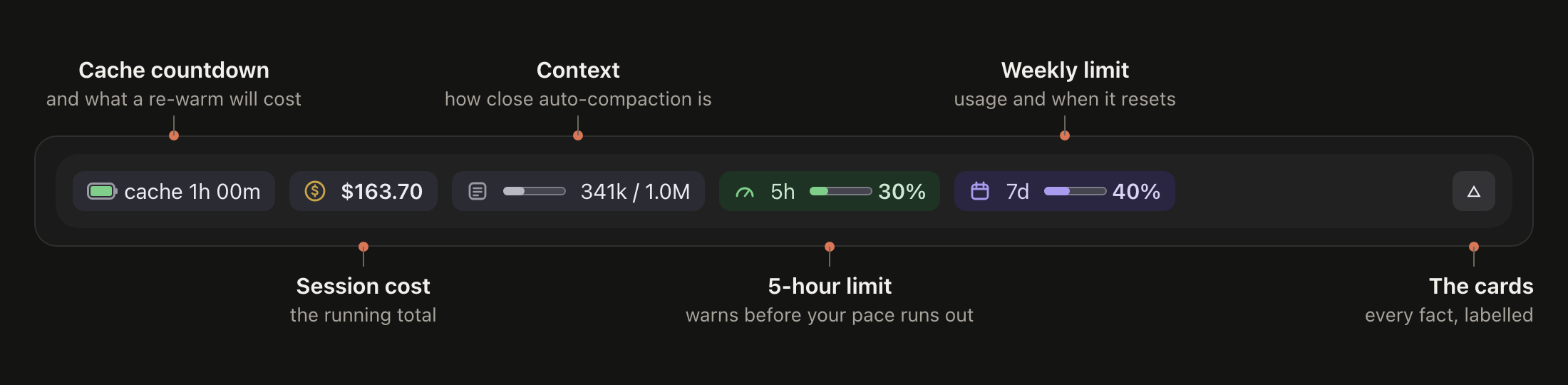
Cache countdown
A battery that drains as the cache ages. In its last minute it turns amber and names the re-warm price.
Session spend
The running total, and what your last message cost on its own.
Context
How full the conversation is, and how close auto-compaction is.
5-hour limit
Usage and the reset, with a warning when your pace would run out first.
Weekly limit
Usage and when it resets. Open ▵ for every fact labelled, under your project and git branch.
The same readings, in three shapes.
Chips is the default. /usage-band layout <name> draws another, and every session draws it from then on; /usage-band layout alone lists them. Each asks one question of the same readings. Chips opens with ▵ into four cards; pulse and departures open into their own views.
chipsIs my cache warm, what is this costing, am I near a limit? The row of chips, with four cards behind ▵. The default.1 row on the desktop, 1 row in the terminal
/usage-band layout chips
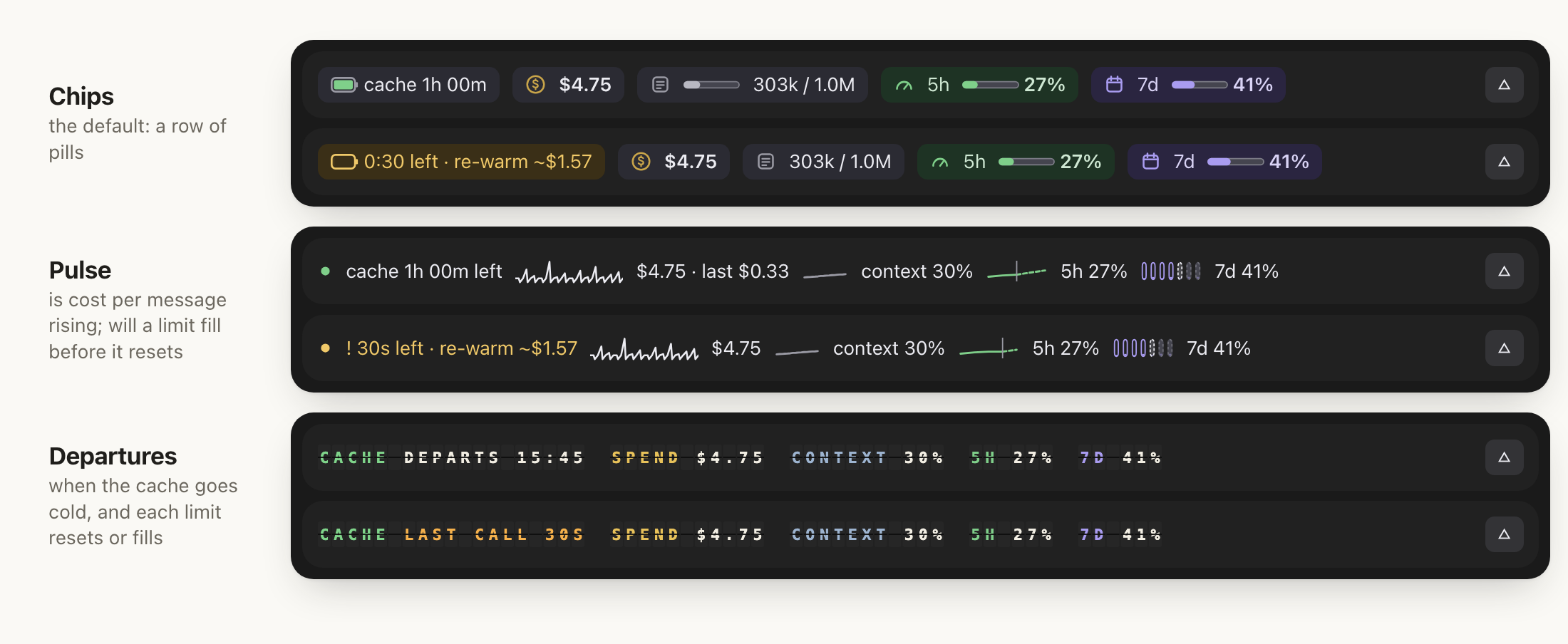
All three at once
The price comes from your own bill.
A mod can't reach a pricing table, so the band solves the per-token rate from the session's cost and token counts. Each kind of token is a fixed multiple of base input, which leaves one unknown.
- A re-warm is the whole context, written againalways shown with
~, since it's an estimate. - It remembers old sessionsreopen one and it recalls the last reply and a token's price, or reads them once from the transcript.
- It stays out of your wayit never calls a model, writes files or sends anything. Besides two read-only git commands, it runs only
tail. - It's a mod, nothing to buildClaude Code's function-hooks API: TypeScript and JSX, no dependencies, about 1,000 tests.
Questions people ask.
Why did my Claude Code message cost so much more than the others?
Most likely the prompt cache went cold. Claude Code caches your conversation for 5 minutes or an hour after the last request. After that, the next message writes the whole conversation to the cache again at 1.25× the input price: on Opus 5.5, 25× what re-reading it from a warm cache costs.
Does it cost tokens?
No. It never calls a model, and it never suggests sending a message to keep the cache warm. That would mean burning tokens to avoid burning tokens.
Is the re-warm price exact?
It's an estimate, shown with ~. It follows Claude Code's own ledger, which prices every cache write at 1.25×. Anthropic bills a 1-hour cache write at 2×, so per-token API users on a 1-hour cache may pay up to 1.6× the estimate.
How does it know if my cache lasts 5 minutes or an hour?
Claude Code uses the hour on a subscription within your plan's usage and 5 minutes on an API key or usage credits. The band can't read your billing, so it assumes an hour and corrects itself to 5 minutes if it sees the cache rebuild sooner. Set CLAUDE_CODE_PROMPT_CACHE_TTL=5m or 1h, or "promptCacheTtl" in settings.json, to remove the guess.
Does it work in the Claude desktop app?
Yes. It draws in the desktop app's Code tab with icons and meters, and in the terminal as text. Tested on Claude Code 2.1.295.
I resumed a session. Does the band start again from $0.00?
No. On a session resumed with claude --resume or /resume, the band takes Claude Code's word on how long it has been idle and what re-caching it would cost, so the cache reads cold or counting down. It also reads the session's transcript once, for what the session spent before and how long the cache was last written for, so the cost and tokens start from there.
The band runs past the edge of my terminal. What can I do?
Set CC_BAND_GLYPHS=ascii. A terminal in a Chinese, Japanese or Korean locale, or one set to draw ambiguous-width characters wide, draws some of the band's glyphs two columns wide. In such a locale the band draws ASCII by itself; the terminal setting can't be detected. Set it with a screen reader too, which reads the braille charts as dots.
Does it work on light themes?
Yes. Set CC_BAND_APPEARANCE=light, or plain for theme colours only. NO_COLOR is respected.
It's brand new. Tell me what you see.
Reports from real sessions are what make the numbers right.
One command, and a cold cache never surprises you again.
Free and open source. Works in the Claude desktop app and the terminal.
$ claude plugin install session-usage-band \
    --marketplace HMarzban/claude-mod


